
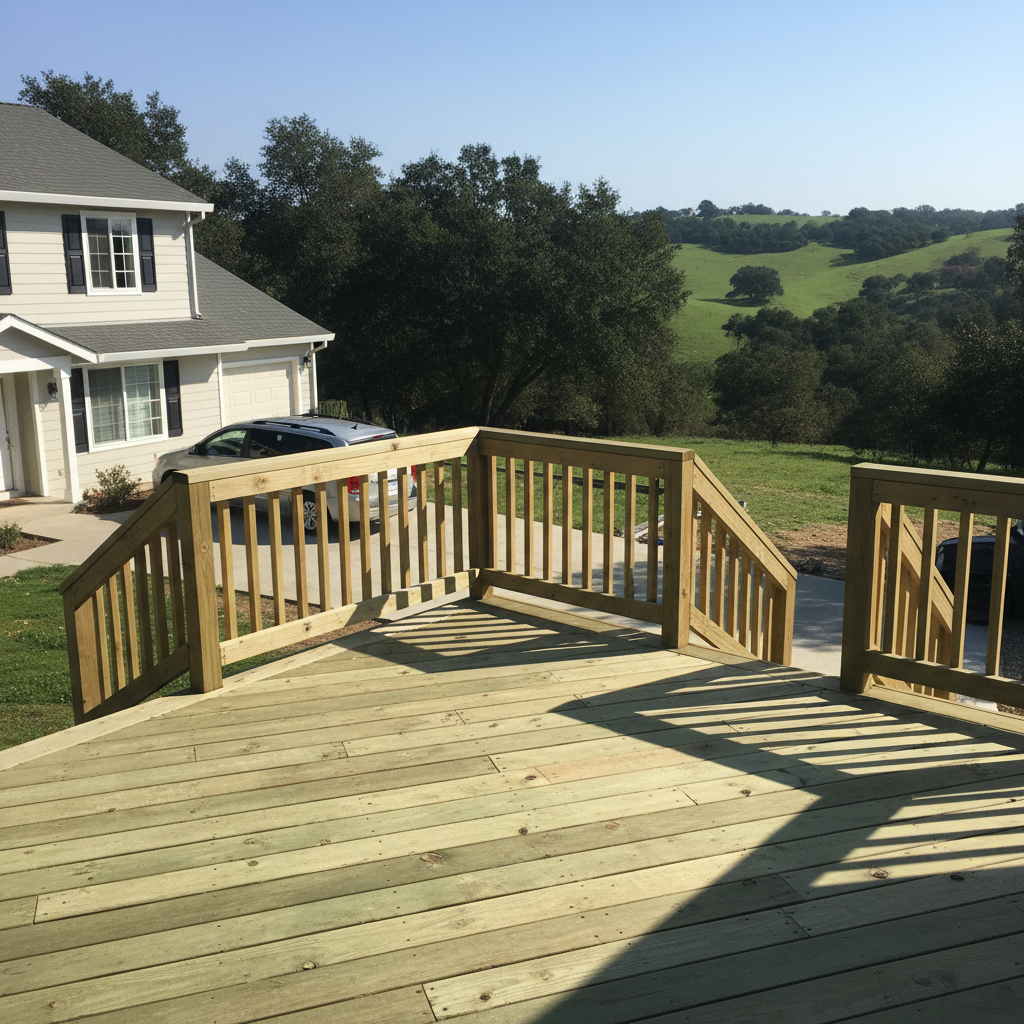
Roseville has a lot of decks going in right now, and a lot of decks that got built fifteen years ago by somebody's brother-in-law and are starting to show it. If you're trying to tell a good builder from a guy with a truck and a nail gun, the questions you ask before signing a contract matter more than anything in the finished product's first coat of stain.
Here's what actually separates a deck that holds up through its second decade from one that's spongy by year six.
Ask who pulls the permit, and don't accept a vague answer
Almost any deck attached to the house needs a permit in California, and most cities, Roseville included, also require one for a freestanding deck once it's more than 30 inches off grade, which is also the height where a guardrail becomes code-required. A builder who tells you permits are optional, or that they'll "just keep it under the radar," is telling you they don't want an inspector looking at their framing. That should bother you.
The permit process in Roseville runs through the city's building division for most jobs in city limits, and through Placer County if your lot sits outside the city boundary. What gets inspected is pretty standard: footing depth and size before you pour, the ledger board attachment to the house, joist hangers and blocking, and the guardrail and stair stringers at final. If your builder can't walk you through that sequence without checking their phone, they haven't pulled many permits.
What the clay soil under your yard means for your footings
A lot of Roseville sits on adobe clay, especially in the older flatland neighborhoods and parts of west Roseville. That soil swells when it's wet and shrinks hard when it dries out, which is exactly the kind of movement that cracks a shallow footing or heaves a deck post over a few seasons. A builder who's worked here knows to get the footing below the active zone, typically 12 to 18 inches, resting on undisturbed soil rather than fill, and sized to the actual load, not just "whatever auger bit I had on the truck."
In the newer subdivisions out toward Fiddyment Farm, Stoneridge, and Westpark, the ground was engineered and compacted as part of the development, so you're dealing with more consistent fill, but it's still fill. Ask what footing diameter and depth they're planning, and ask if they've checked the soil or just eyeballed it. A real answer sounds like numbers. A non-answer sounds like reassurance.
Lumber, composite, and what the Roseville summer does to both
July and August here routinely sit in the high 90s to low 100s, and that heat does real things to decking material. Composite boards expand and contract across their length as temperatures swing, so a builder who doesn't leave the manufacturer's specified gap between boards, usually around 3/16 to 1/4 inch depending on the brand, is setting you up for buckling in year two. Pressure-treated lumber, meanwhile, needs to acclimate on site for a few days before it's installed wet off the truck, or it shrinks and twists once it dries in the heat.
Staining has its own timing problem. Applying sealant in direct afternoon sun when the board surface is pushing 120 degrees means it flashes off before it penetrates, and you get a coat that looks fine for a month and peels by spring. A builder who schedules staining for early morning or an overcast day in spring or fall, rather than squeezing it in whenever the crew is free, is paying attention to something that actually affects how long the finish lasts.
The contract details that tell you who you're dealing with
- A deposit over 10% of the total job cost, or a demand for the full amount up front, is worth walking away from. California law caps deposits on home improvement contracts at 10% or $1,000, whichever is less, and a builder who ignores that isn't following the rest of the rules either.
- Ask to see their contractor's license number and look it up yourself on the CSLB website. It takes two minutes and tells you if there's a bond, insurance on file, and any complaint history.
- Get the span tables and joist spacing in writing, not just a verbal promise of "it'll be solid." 16 inches on center is standard for most decking, but composite often needs tighter spacing, sometimes 12 inches, and a builder quoting a flat price without specifying this is guessing at material costs too.
- A lien waiver at final payment protects you if the builder didn't pay a supplier. Ask for one. If they've never heard of it, that's a gap.
Older streets versus new subdivisions
A repair or rebuild in older Roseville neighborhoods, Old Town or Sierra Gardens for example, often turns up decks that were built before current attachment standards existed, meaning the ledger board might be nailed instead of lag-bolted and flashed, with no real connection to resist the deck pulling away from the house under load. That's the failure that shows up in the news every few years, a deck collapsing because the ledger let go, and it's almost always an older, unpermitted structure.
Newer subdivisions bring a different wrinkle: HOA design review. Most of the newer Roseville developments have an architectural committee that wants to approve deck height, railing style, and sometimes stain color before the city will even look at your permit application. A builder who's done work in your specific neighborhood will know whether that step exists and how long it typically takes, which can be two to four weeks depending on how often the committee meets.
What to walk away from
Walk away from anyone who won't give you a written estimate broken into labor and material. Walk away from anyone who can't tell you what footing depth they're planning before they've even looked at your yard. Walk away from a quote that's dramatically lower than two others for the same square footage and the same material, because somewhere in that number they're cutting footings, fasteners, or flashing, and you won't see it until the deck is ten years old and the ledger's rotted out behind the siding.
A good deck in this climate, built on a footing that accounts for the clay, with the right gap left in the composite and the ledger properly flashed against our rainy months, should give you thirty years with nothing more than a re-stain every few seasons. That's the bar. If you want to talk through what that looks like for your yard specifically, Ridgewood Deck Builders is a good place to start the conversation.